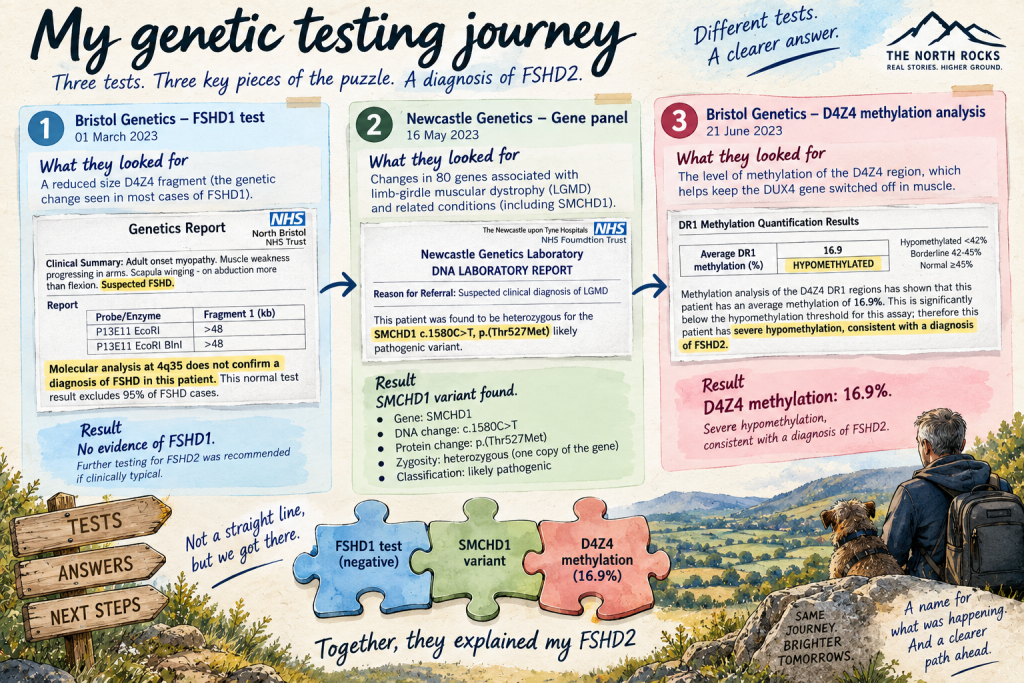
SMCHD1 c.1580C>T p.(Thr527Met). D4Z4 DR1 methylation: 16.9%. Severe hypomethylation.
Those are some of the words and numbers that finally explained why my muscles weren’t working properly. Obviously, I knew exactly what they meant. No. I didn’t have a bloody clue.
I’d spent years trying to find out what was happening to my body. Eventually the answer arrived in a language that might as well have been written for somebody else. So this is my attempt to translate it.
What did my genetic tests actually find? Why did that mean I have FSHD2? And, perhaps just as importantly, what didn’t those results tell me?
First, apparently I didn’t have FSHD
Well, sort of.
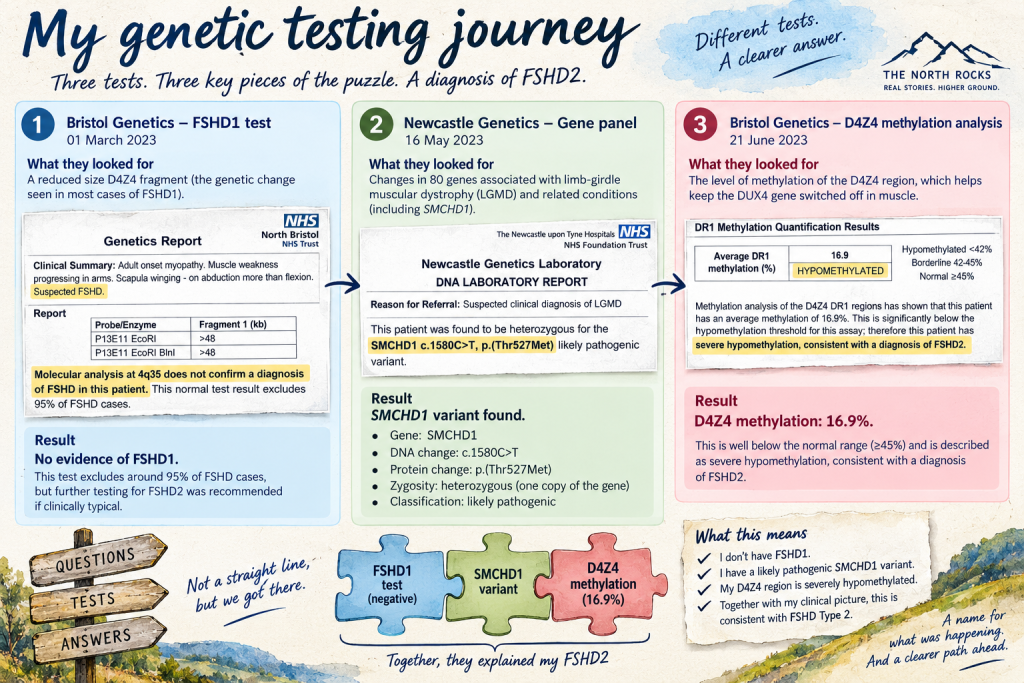
By the time my first specific FSHD test was done, FSHD was already suspected. The clinical summary on the report says exactly that: “Suspected FSHD.”
The result, though, was normal. The test was looking for the genetic change responsible for the vast majority of cases of FSHD — what we now call FSHD1. 95% of FSHD diagnosis is for Type 1.
It didn’t find it. The report said:
“Molecular analysis at 4q35 does not confirm a diagnosis of FSHD in this patient.”
After spending years looking for an answer, that might sound like another dead end, but there was another sentence. The report explained that among the remaining clinically typical cases, the majority were FSHD2, and that further testing could be undertaken.
So the answer wasn’t “you don’t have FSHD.” It was closer to:
“You don’t have the common form of FSHD. We’d better keep looking.”
Then they found something
The next report came from Newcastle. Oddly, this one gives the reason for referral as: “Suspected clinical diagnosis of LGMD.”
LGMD is limb-girdle muscular dystrophy. I’ve always found that slightly strange because FSHD was clearly already on the table by then. I’d already had the Bristol FSHD test.
This was a broad genetic panel looking at 80 genes associated with LGMD and conditions that can produce similar symptoms. And buried among them was something rather important.
SMCHD1.
More specifically:
SMCHD1 c.1580C>T p.(Thr527Met) — likely pathogenic.
Which is tremendously helpful if you happen to speak fluent geneticist. I don’t. So let’s dismantle it.
SMCHD1 is the name of the gene.
c.1580C>T describes a change in its DNA. At position 1580, a C has been replaced by a T.
That change affects the protein made from the gene. Hence the next bit:
p.(Thr527Met).
At position 527 in the protein, an amino acid called threonine has been replaced by another called methionine.
And heterozygous, another word on my report, simply means that this change was found in one of my two copies of the gene. Suddenly:
SMCHD1 c.1580C>T p.(Thr527Met)
isn’t quite so terrifying.
But they still weren’t finished
This is an important bit. Finding the SMCHD1 variant wasn’t, by itself, the final answer. The Newcastle laboratory classified it as likely pathogenic, but their report also acknowledged some uncertainty about this particular variant. So they sent things back towards Bristol for another piece of the puzzle:
D4Z4 methylation analysis.
Another phrase I definitely wasn’t using in everyday conversation at the time. To understand why that mattered, we need to talk about what goes wrong in FSHD. And I’ll try to do it without requiring a degree in molecular genetics.
There’s something in my DNA that should be kept quiet
Ultimately, FSHD revolves around a gene called DUX4. DUX4 isn’t inherently some evil gene that shouldn’t exist. It has useful roles at particular stages of human development.
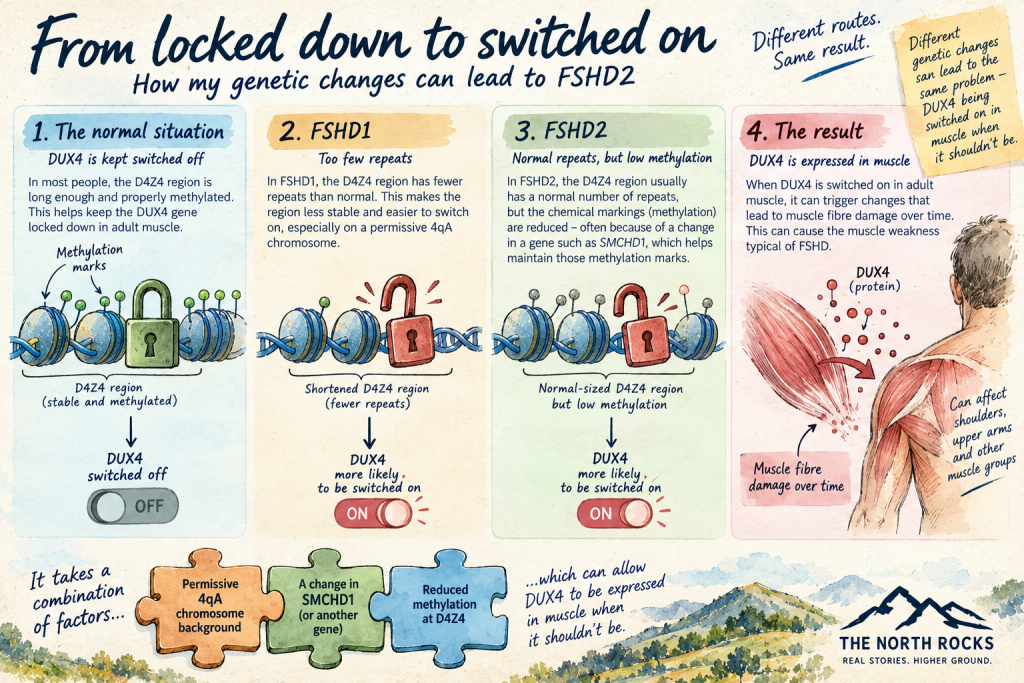
The problem is that in adult skeletal muscle it should normally be kept switched off. Think of it as something behind a locked door. One part of the system helping keep that door shut involves a repetitive stretch of DNA called D4Z4.
Another part involves chemical markings on DNA called methylation. You don’t really need to remember either name. The important bit is this: the machinery is supposed to keep DUX4 quiet.
In FSHD, that control starts to fail. In FSHD1, the D4Z4 region is unusually short because some of its repeated sections are missing.
FSHD2 gets to much the same destination by a different route. One of the genes involved in keeping the D4Z4 region properly repressed is…SMCHD1.
Ah. Now we’re getting somewhere.
And then came 16.9%
My final report is dated 21 June 2023. This time Bristol measured methylation in the D4Z4 region. The report gives these reference points:
Normal: 45% or higher. Borderline: 42–45%. Hypomethylated: below 42%.
Mine was: 16.9%.
The report describes that as: “severe hypomethylation, consistent with a diagnosis of FSHD2.” Suddenly the pieces fitted together. I had the symptoms.
The usual FSHD1 genetic test had been negative. Another genetic test had found a likely pathogenic variant in SMCHD1. The D4Z4 region that should have been kept tightly repressed was severely hypomethylated.
There was finally a name for what was happening to me. FSHD Type 2.
Different route. Same problem.
This was one of the things I initially struggled to understand about FSHD1 and FSHD2. They’re not simply “Type 1 is worse than Type 2”, or two different severities of the same genetic defect. They’re different genetic routes towards essentially the same biological problem.
In both, the normal controls that should keep DUX4 switched off in adult muscle aren’t working properly. DUX4 can then be expressed where it shouldn’t be, setting off processes that damage muscle cells.
That is why somebody with FSHD1 and somebody with FSHD2 can look clinically very similar even though the genetic explanation underneath is different.
That is why my first FSHD test could be negative while I still had FSHD. It was looking primarily for the road marked FSHD1. I was on the other road.
So what did my genetic result actually tell me?
It told me something enormously important. Why.
It connected the shoulder weakness, the scapular winging, the changes in my arms and legs and all those years of knowing that something wasn’t right.
It gave my doctors evidence for a specific diagnosis, and it gave me a name for the thing I’d been trying to understand.
There’s another side to genetic testing which I think is equally important. It didn’t give me a crystal ball. My result doesn’t tell me exactly which muscles will weaken next. It doesn’t tell me how quickly my FSHD will progress. It doesn’t tell me what I’ll be capable of in five, ten or twenty years.
And 16.9% isn’t a score for how badly affected I am.
That’s important. It’s a laboratory measurement that helped establish what was happening biologically. It isn’t a percentage telling me how much muscle function I’ve got left.
They’re just numbers. Except they’re not.
Looking back, there’s something slightly absurd about the whole thing. For years I wanted somebody to tell me what was wrong with me. Eventually they did. And the answer was:
SMCHD1 c.1580C>T p.(Thr527Met). D4Z4 DR1 methylation: 16.9%.
Not exactly the moment of clarity I’d imagined, but once somebody translates those words and numbers, they tell quite a story.
The first test didn’t find FSHD1. The next found a clue in SMCHD1. The final one found the severe hypomethylation that helped everything fall into place.
None of those results changed my body. I was exactly the same person the day after the diagnosis as I had been the day before it.
But something had changed. After years of uncertainty, I finally knew why, and sometimes, knowing what you’re dealing with matters.