Before I start…
This article is about my experience of exercise and FSHD. It affects people very differently. What I can do, what helps me and how my body responds to exercise may be completely different from someone else’s experience.
I’m not a medical professional, and I’m certainly not suggesting that anybody with FSHD should copy what I’m doing. Exercise needs to be appropriate to the individual, particularly where there is significant muscle weakness or other health considerations.
Please don’t use my experience as medical advice. If you’re thinking about changing how much or what type of exercise you do, talk to an appropriate healthcare professional who understands your circumstances.
With that said, this is what happened to me.
My legs just wouldn’t go
Long before I knew I had FSHD, I knew that something strange was happening when I ran. I’d been running for years, so I knew what being tired felt like. This wasn’t quite the same.
Sometimes my legs felt incredibly heavy and weak. I’d complain that “my legs just won’t go.” I didn’t mean that running was difficult. I meant that sometimes I felt like I simply could not run.
There was another strange thing too. If I could keep running, I could often keep going. But if I stopped, getting started again could be really, really hard. An untied shoelace could be a complete bloody nightmare.
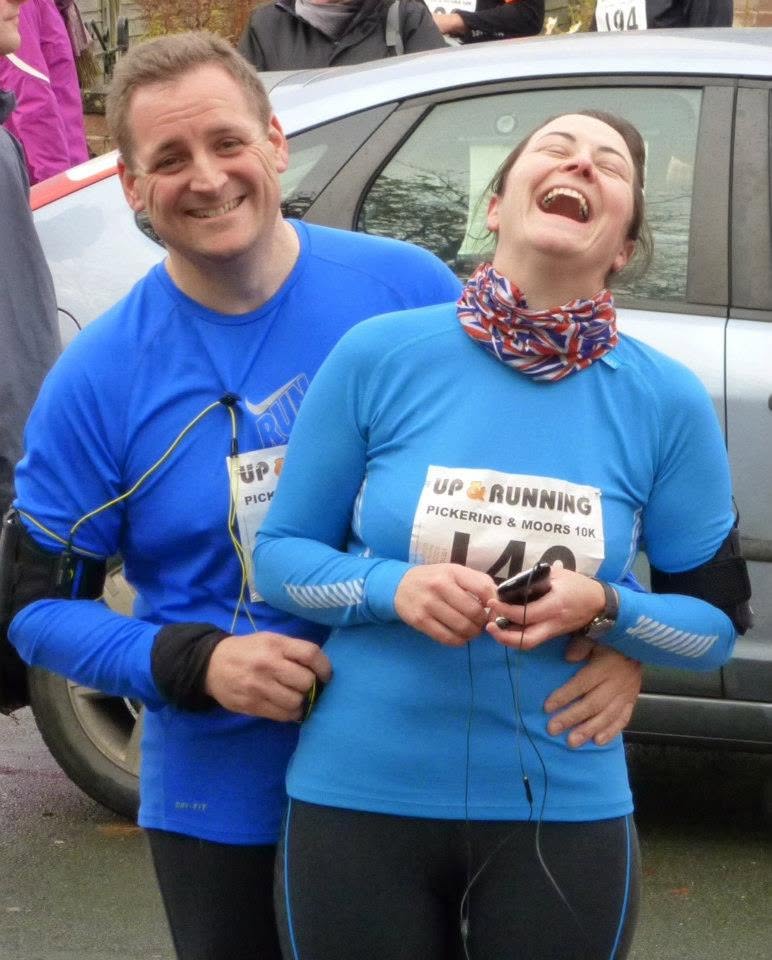
Running hadn’t always been like that. Hayley and I had discovered running together. We entered races, did parkruns, ran 10Ks, half marathons and trail races.
We weren’t particularly brilliant at it, but that wasn’t really the point. It was fun. It gave us a sense of achievement. It was something we did together. And gradually, for me, it stopped being fun.
I remember the Thirsk 10 Mile particularly clearly. There was simply nothing in the tank, right from the start. My legs just wouldn’t go.
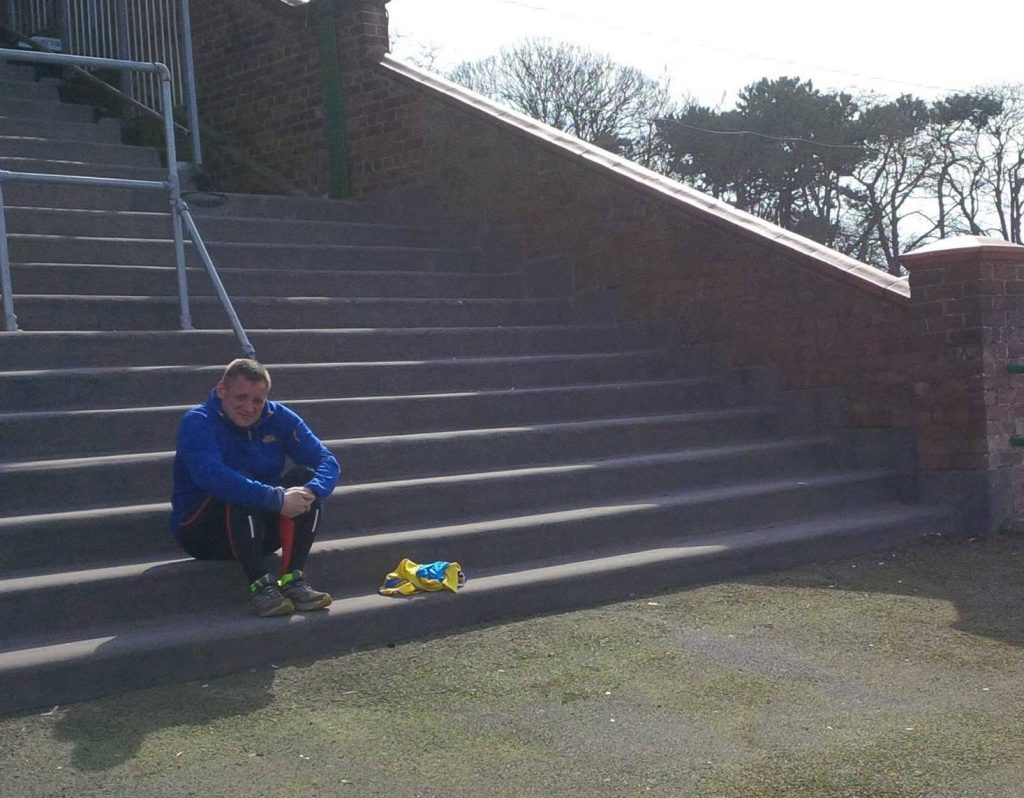
So I stopped
When the investigation into my muscle problems began, there was a period when nobody knew what was wrong with me. The message I took away was:
“Exercise might be damaging you muscles. We honestly don’t know. You need to stop.”
So I did. And my behaviour changed very quickly. I didn’t just stop running. I pretty much stopped everything. I still walked a couple of kilometres most days with the dogs and did a little work in the garden, but nothing remotely like I’d done previously.
The long walks disappeared. Running disappeared. I stopped deliberately testing myself physically. At the time, that seemed like the sensible thing to do. I thought I was protecting my muscles.
But stopping wasn’t helping
The problem was that I still got fatigued. I still had massive amounts of pain. And now I was becoming increasingly unfit as well. I gained weight. Physical activity became harder. And because it was harder, I did less of it. It became a cycle.
I’ve no way of knowing how much of the change during those years was the progression of FSHD and how much was the result of becoming less active. But eventually I realised something very simple:
Not exercising wasn’t helping me.
That’s an important distinction. I’m not saying that I discovered exercise was treating my FSHD. I didn’t. I realised that doing almost nothing wasn’t preserving the person I’d been either. Something needed to change.
Unfortunately, the answer was swimming
Around my birthday in September 2025, I took a good look at myself and decided I needed to do something. So I started swimming two or three times a week. There was one slight problem with this plan. I hate swimming.
I still hate swimming. And it certainly didn’t transform my body into one that other blokes in the pool looked at and thought, he looks great. 😁
But it did something considerably more important. It started to make me feel capable again. Some swims were good. Some absolutely weren’t.
Even now, I can usually tell quite quickly whether I’m having a worthwhile swim or one where I might as well not have bothered. I don’t know why. That’s simply how my body behaves.
Things started moving in the right direction
Hayley helped me enormously. She started paying much more attention to my nutrition and making sure I was properly fuelled with the right things — mostly. 😁
During 2026, my weight started coming down and I found I could walk further. Then I joined the walking group at Hambleton Athletics & Running Club. That gave me something else I hadn’t realised I needed quite so much: encouragement and emotional support.
The early walks weren’t easy. In February 2026, I could be fatigued after walking just 2 km on the flat. But I was moving again.
And, little by little, I started to believe something that I hadn’t believed for quite a long time. I felt I could achieve something great if I worked hard at it. That’s eventually how I ended up starting to walk the Cleveland Way.
What does the science say?
My original concern about exercise wasn’t completely irrational.
Exercise in FSHD has historically been approached cautiously because of concerns about overwork weakness and the possibility that working already weakened muscles too hard could cause further damage. A 2026 review of exercise in FSHD describes that history, but also highlights the other side of the equation: inactivity can contribute to deconditioning and loss of physical capacity.
The evidence today is more encouraging than the message I understood all those years ago.
Evidence-based clinical guidance has concluded that aerobic exercise appears safe and potentially beneficial for people with FSHD, and studies of low-intensity aerobic training have found improvements in exercise performance without signs of muscle damage. But that does not mean that more exercise is always better.
FSHD varies enormously between people, and the research base is still relatively small. The latest review emphasises the need for exercise to be tailored to the individual rather than treating everybody with FSHD in the same way.
Which brings me back to the question in the title.
How much is too much?
I don’t know. More importantly, I don’t think it’s the same every day. There are days when a 5 km walk feels like utter drudgery from beginning to end. Then there are other days when I can walk 19 km through the hills. I’m completely finished at the end of it, obviously, but I can do it.
That’s an extraordinary change from being fatigued after 2 km on the flat only seven months earlier.
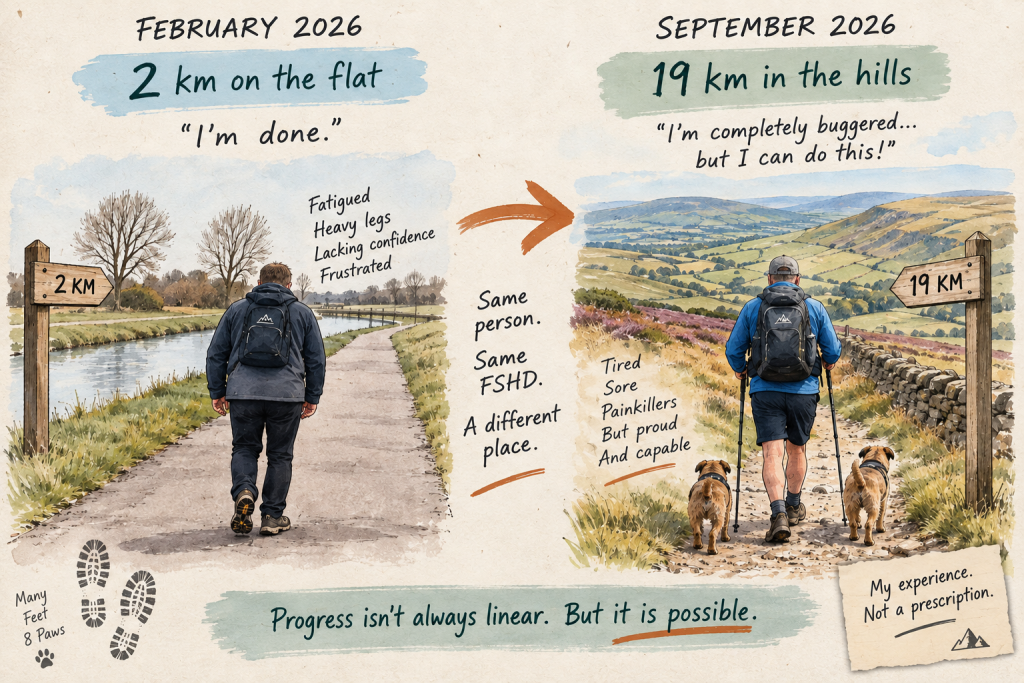
Again, I’m not claiming that exercise has reversed my FSHD. It hasn’t. I still have weakness. I still have pain. I still experience fatigue. And sometimes my body simply isn’t interested in what I’ve planned for it that day.
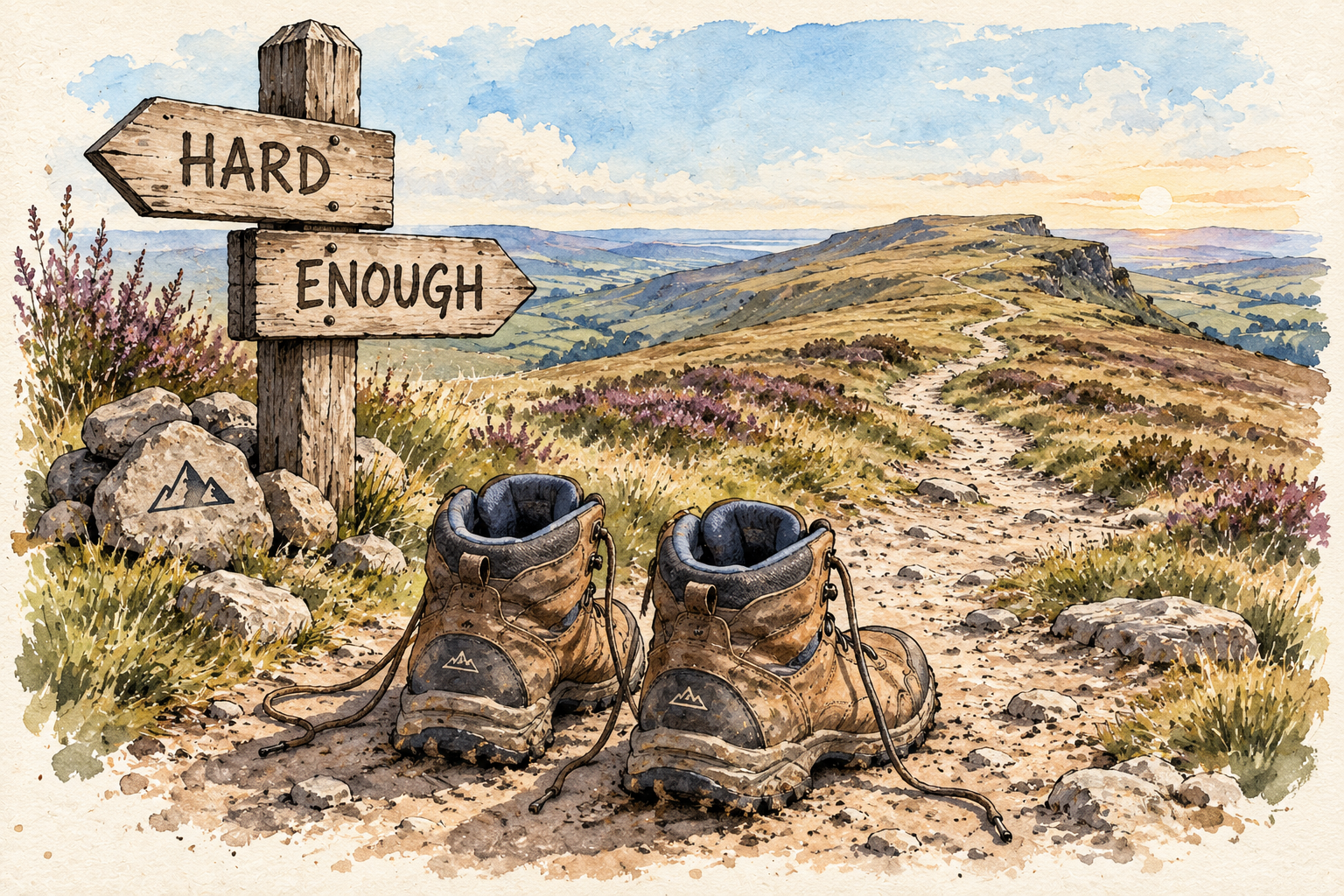
Hard isn’t the same as enough
One of the things I’m learning is that there is a difference between something being hard and reaching enough. I definitely have an enough point. On one of my recent walks, I found it at around 18 km.
What’s encouraging is that the point seems to be getting further away. I can do more before I reach it. Walking has also taught me to pay more attention to how I’m moving.
I often start feeling problems around my hips. I also have a tendency to hunch or lean forward as I walk. Sometimes, if I notice that happening and deliberately change my posture and the way I’m moving, I can alleviate some of the problem and carry on.
That’s not an FSHD treatment recommendation. It’s simply something I’ve learned about my body. I’ve become much better at listening to it.
Sometimes it says this is hard. Sometimes it says today is going to be rubbish. And sometimes it says: That’s enough now, Gary. I’m getting better at hearing the difference.
The day after the day after
Recovery is equally unpredictable. After one recent 19 km walk in the hills, I sat down with Richard and we had a few beers. Later I drank plenty of water, took my usual supplements, ate a good meal — pretty much anything I wanted by that point — and slept well.
The following morning I was stiff as a board, but I got up and walked with the dogs, into town for coffee. You might think that’s the end of the recovery story.It isn’t.
Hayley and I have a phrase for what often comes next:
“The day after the day after.”
That’s frequently the difficult one. That’s when I can really struggle to get going and have to make a conscious effort to start moving. I don’t know why. I’m not particularly interested in trying to give everything my body does a scientific explanation.
It’s just the way it is. And learning that pattern is part of learning how to live — and exercise — with the body I’ve got.
So, how much exercise should someone with FSHD do?
I’m absolutely the wrong person to answer that question for anybody other than me. I can tell you what I’ve learned about myself.
I’ve learned that my body is capable of considerably more than I thought it was a year ago. I’ve learned that some days are better than others for reasons I don’t understand.
I’ve learned that pain and fatigue don’t automatically mean I’ve reached my limit. I’ve learned that hard and enough aren’t necessarily the same thing. And …I’ve learned that when I do reach enough, I need to respect it.
Current research gives me reassurance that appropriately chosen exercise can have a place in living with FSHD, but it doesn’t give me — or anybody else — a magic number of kilometres, lengths of a swimming pool or minutes of exercise that is right for everyone even for that day.
That’s why the warning at the beginning of this article matters. This is my experience.
I can do this
There’s one photograph from our running days that I particularly like. Hayley and I had just finished our first 10K.
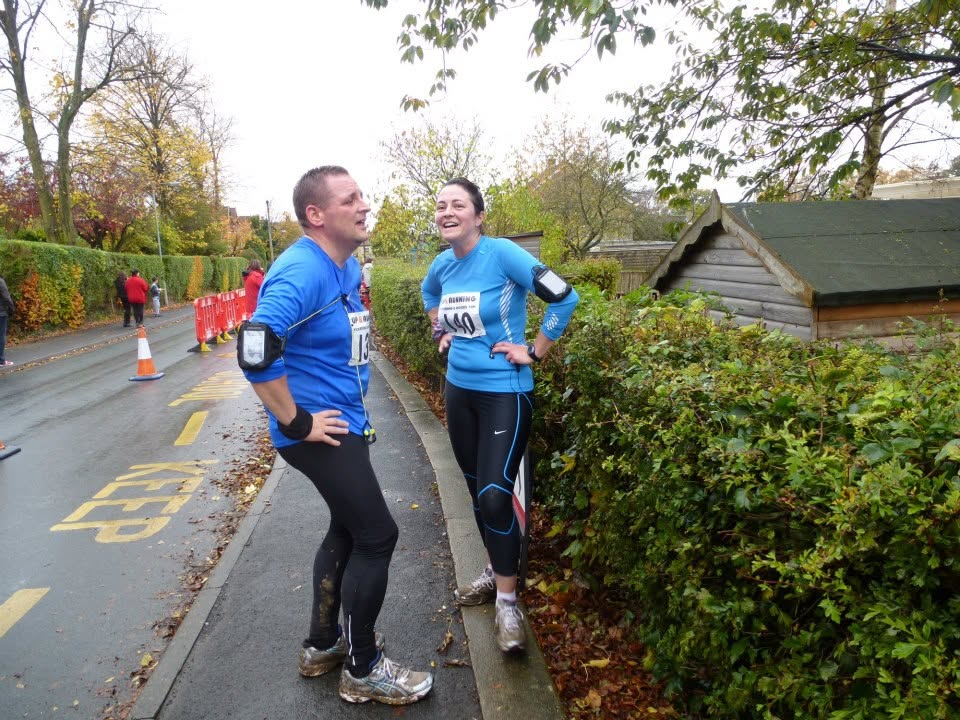
Look at us. There’s exhaustion there, certainly, but there’s something else. Achievement. Satisfaction.
We actually did that.
I recognise that feeling again now. Seven months ago, walking 2 km on the flat could leave me fatigued. Now I’m walking through the hills for 19 km. I still have FSHD.
I still have bad days. My muscles still hurt. I still get fatigued. And there are still mornings when getting myself moving feels like an enormous effort. Something has changed though.
For several years, I was frightened about what exercise might do to my body. Eventually I had to confront what not exercising was doing to my life. And now? I’m walking the Cleveland Way.
I’m pushing myself. I’m learning where hard becomes enough. And every so often I find myself thinking: I can do this.