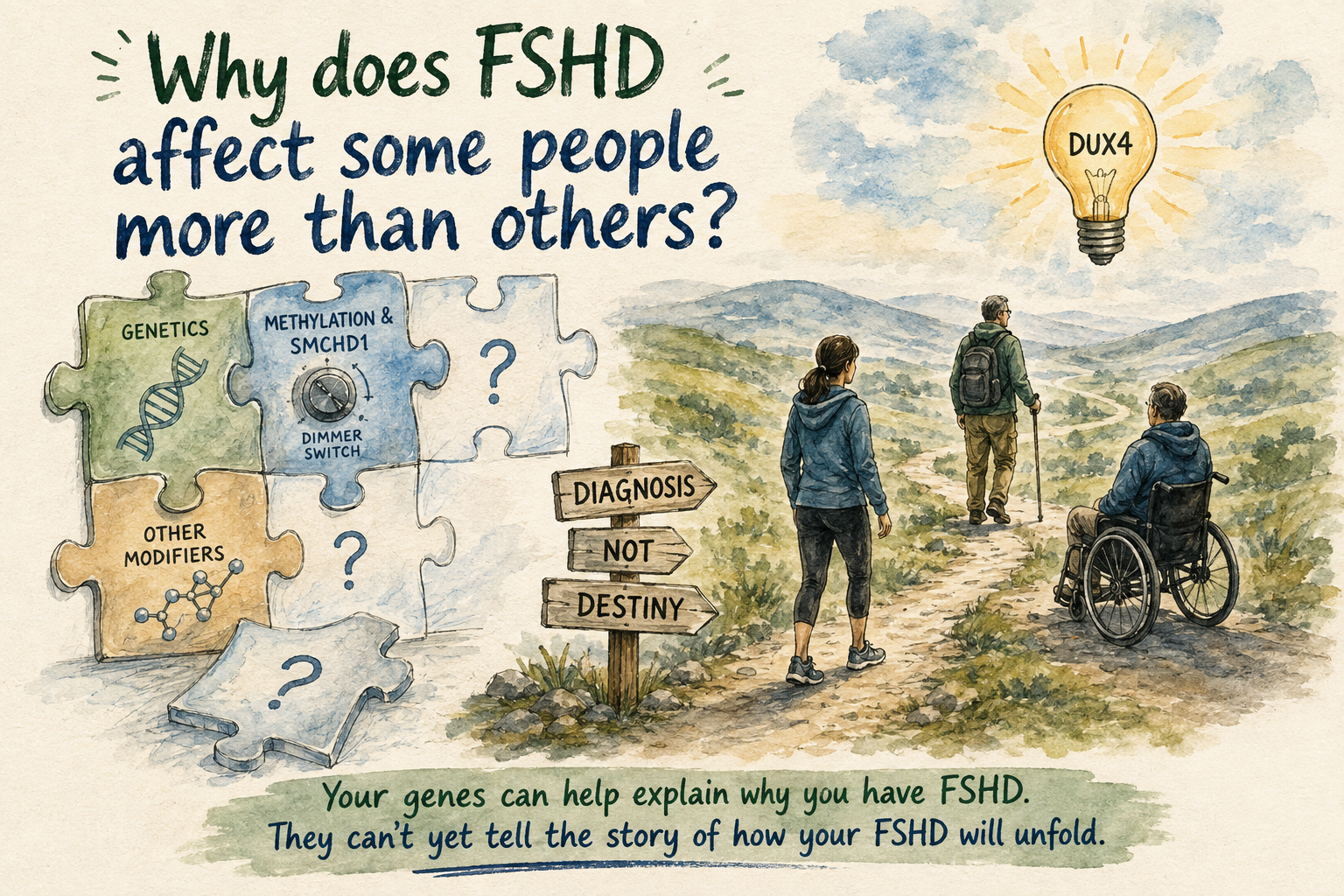
One of the strangest things about FSHD is just how different it can look from one person to another. Someone can live with relatively mild symptoms for many years. Someone else can be significantly affected much earlier in life.
And perhaps most surprisingly, two people in the same family can have very different experiences of FSHD.
So why? The answer is slightly frustrating. We know some of the reasons. But we don’t know all of them. In fact, there’s still an awful lot we don’t understand.
Same diagnosis. Different lives.
FSHD isn’t a condition that follows a standard path.
The age at which symptoms first appear can vary enormously. So can the muscles affected, the severity of the weakness and how the condition changes over time.
Some people remain relatively mildly affected throughout their lives. Others experience much more significant muscle weakness and disability.
That variability isn’t unusual in FSHD. It’s actually one of its defining characteristics.

The genetic starting point matters
Let’s start with something we do know. In FSHD1, part of the story involves a region of DNA called D4Z4. Most people have quite a long string of repeated D4Z4 units. In someone with FSHD1, that string has become much shorter.
Broadly speaking, very short D4Z4 arrays — particularly those with only a few repeats — tend to be associated with earlier onset and more severe FSHD.
But here’s the important bit: It’s an association. It isn’t a prediction.
People with similar D4Z4 repeat sizes can still experience FSHD very differently. The genetic starting point matters. But it clearly isn’t the whole story.

Then there’s the dimmer switch
If you’ve read my article about the difference between FSHD1 and FSHD2, you’ll have met this idea before. Our DNA doesn’t simply consist of genes that are either permanently ON or permanently OFF.
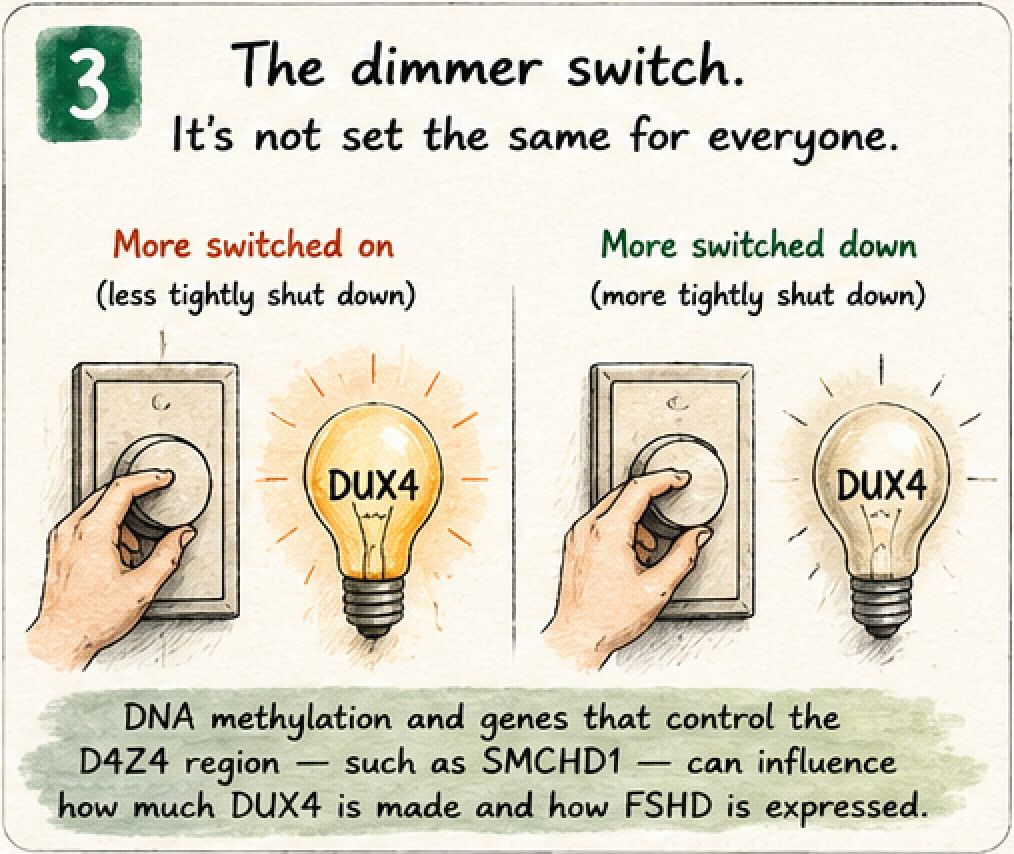
The body has mechanisms that help control how accessible different parts of our DNA are. One of those mechanisms involves something called DNA methylation. Think of it a little like a dimmer switch.
In FSHD, the D4Z4 region isn’t kept as tightly switched down as it normally would be. That contributes to inappropriate production of DUX4, the protein at the centre of the FSHD disease process.
Genes involved in controlling this region matter too. SMCHD1, for example, is important in FSHD2 but can also modify how FSHD1 is expressed.
So we’re already beginning to see why simply counting D4Z4 repeats can’t tell us everything. There are other controls involved.
Even the same family can be different
This is perhaps the clearest demonstration that FSHD isn’t governed by one simple genetic rule. People within the same family can carry the same FSHD-associated genetic change and yet experience the condition very differently.
One person might develop noticeable symptoms relatively early. Another might be much more mildly affected. Someone else may carry the genetic change and have very few obvious symptoms at all.
That can understandably be confusing — particularly for somebody newly diagnosed who looks at an affected parent or other relative and wonders:
“Is that what is going to happen to me?”
The answer is that their experience cannot tell you exactly what yours will be. Same family. Same condition. Potentially a very different story.

There are pieces we haven’t found yet
And this, for me, is the really important part.
It’s tempting to think that because researchers now understand a great deal about the genetic mechanisms behind FSHD, we should be able to look at someone’s genetic results and explain exactly why their condition looks the way it does.
We can’t.
Researchers have identified some of the pieces of the puzzle. We know the genetic starting point matters. We know the regulation of the D4Z4 region matters.
We know that genetic and epigenetic modifiers can influence what happens. But we don’t have anything close to the complete picture yet.
There are people whose FSHD is considerably milder or more severe than might be expected from their genetic results.
There are families in which people with closely related genetic backgrounds have strikingly different experiences of the condition.
Something else is going on. Probably several other things. And working out what those things are remains an important part of FSHD research.

And that doesn’t mean you did something wrong
I think this is worth saying. When we don’t understand why one person’s FSHD is more severe than another’s, it’s very easy to start looking for explanations ourselves.
Was it exercise? Diet? Weight? Stress? Something I did? Something I didn’t do?
There are plenty of good reasons for looking after ourselves, staying active where we’re able and making choices that support our general health. We shouldn’t turn gaps in scientific knowledge into self-blame.
We simply don’t yet understand all the factors that determine why FSHD develops so differently between individuals.Not knowing the answer doesn’t give us permission to invent one.
A genetic test isn’t a fortune teller
Genetic testing has transformed our ability to diagnose FSHD.
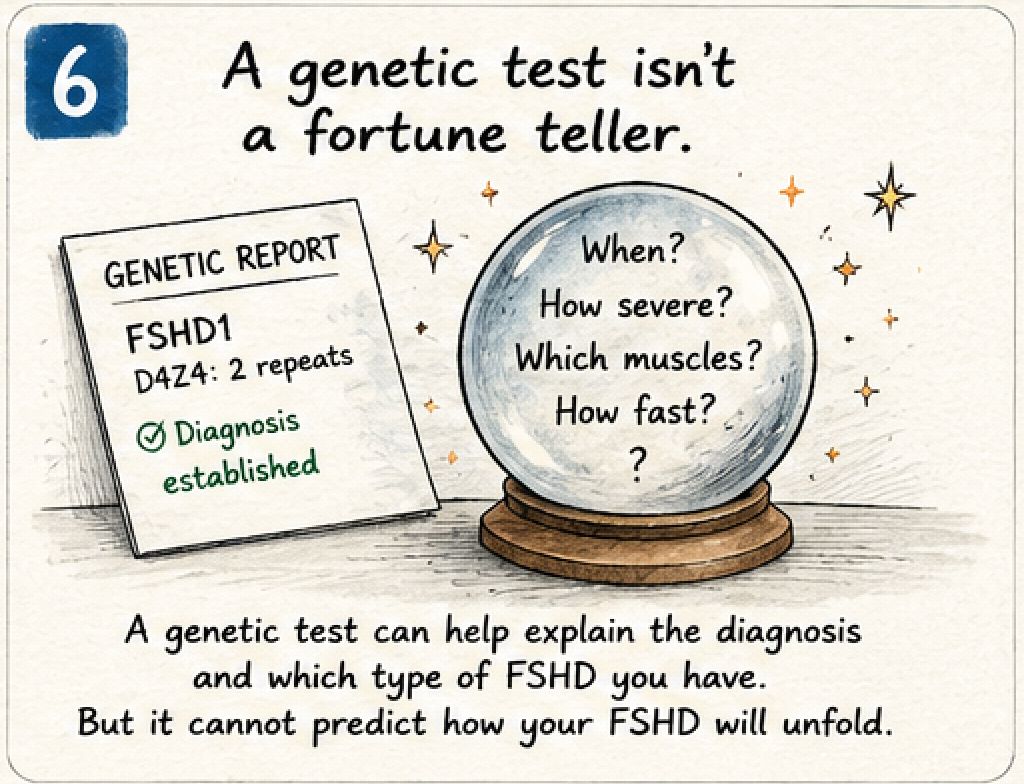
It can help establish whether the biological changes associated with FSHD are present and help distinguish between FSHD1 and FSHD2.
That’s incredibly valuable. But there’s something it can’t currently do. It can’t look into the future.
A genetic result cannot reliably tell someone exactly when their symptoms will begin, which muscles will eventually be affected, how quickly their FSHD will progress or how severely they will ultimately be affected.
That may change. As researchers understand more about genetic modifiers, epigenetics and the other pieces of the puzzle, our ability to predict what FSHD might look like for an individual may improve.
But we’re not there yet.
We know much more. And we still have much to learn.
FSHD research has come an extraordinary distance.
We now understand biological mechanisms that weren’t understood when previous generations of families were living with this condition.
We know about D4Z4. We know about DUX4. We know about methylation and genes such as SMCHD1.
And that growing understanding is helping researchers pursue treatments that would once have seemed impossible.
But understanding why one particular person’s FSHD behaves the way it does is a different challenge. There are still missing pieces.
For someone living with FSHD, that uncertainty can sometimes be difficult, but it also means that somebody else’s experience — even the experience of someone in your own family — isn’t necessarily a preview of your future.
Your genes can help explain why you have FSHD. They can’t yet tell the story of how your FSHD will unfold.
A note from me
I’m writing this as someone living with FSHD, rather than as a medical professional.
These articles are intended to make some of the complicated science around FSHD easier to understand and to share what living with the condition can mean. They shouldn’t replace advice from your own healthcare team.
A single-page version
If you’d prefer the whole explanation on one page, you can download/save the infographic below.
