
There isn’t really a list of “the symptoms of FSHD.”
There are symptoms that are typical of FSHD, but that doesn’t mean everybody gets all of them, gets them in the same order, or experiences them to the same degree.
FSHD can be frustratingly individual. So think of what follows as a map of the territory, rather than a prediction of the journey.
The face
The F in FSHD stands for facio — the face.
Some people with FSHD have weakness in the muscles around the eyes and mouth. That might mean difficulty closing the eyes completely, whistling, drinking through a straw or making certain facial expressions.
For some people it’s obvious. For others it’s extremely subtle — and some people have little or no noticeable facial weakness.
That’s worth remembering right from the start: Typical doesn’t mean inevitable.

Shoulders and upper arms
This is probably the bit people most readily associate with FSHD.
The muscles that hold the shoulder blades in position can weaken. When that happens, the shoulder blades can stick out from the back — something usually called scapular winging.
Weakness around the shoulders and upper arms can make reaching above shoulder height difficult. Things like putting something on a high shelf, washing your hair or changing a lightbulb can become surprisingly hard.
And, of course, those three areas give the condition its rather unwieldy name:
Facio – Scapulo – Humeral. Face. Shoulder blades. Upper arms.

The core and trunk
This one can be easier to miss. FSHD can weaken the muscles of the abdomen and trunk.
That can affect posture and stability and sometimes produces an exaggerated curve in the lower back, known as lordosis.
It can also make things such as sitting up from lying down, maintaining posture or stabilising the body more difficult.
Like everything else with FSHD, the extent to which this happens varies considerably from person to person.

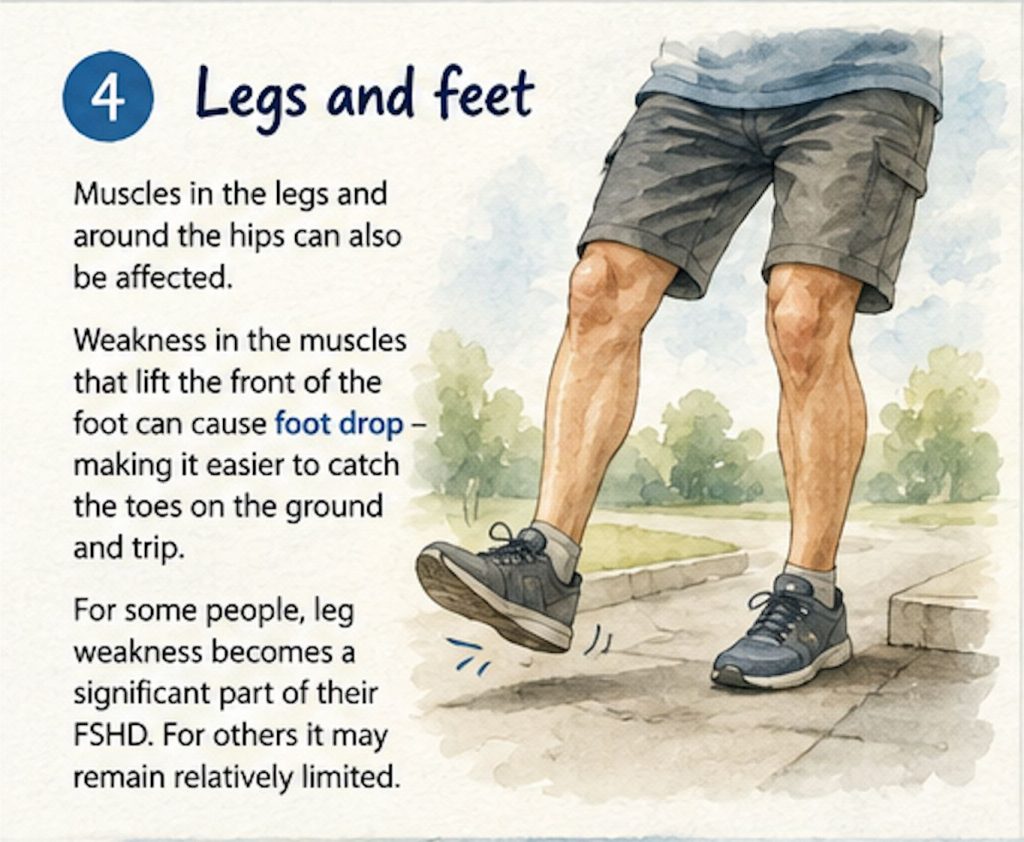
Legs and feet
Despite the name, FSHD isn’t confined to the upper body. Muscles in the legs and around the hips can also be affected.
One characteristic problem is weakness in the muscles that lift the front of the foot. This can cause foot drop — making it easier to catch the toes on the ground and trip.
For some people, leg weakness becomes a significant part of their FSHD. For others it may remain relatively limited.
Again: Same condition. Very different experiences.
One side doesn’t always match the other
Here’s one of the more peculiar features of FSHD. It can be asymmetrical.
One shoulder might be considerably weaker than the other. One arm or leg can be affected differently from its partner. Even facial weakness can be uneven. It’s one of the characteristic features of FSHD.
It also means that looking at a neat anatomical diagram showing identical weakness on both sides of the body doesn’t really capture what FSHD can look like in real life.
FSHD isn’t always neat.

And then there are the things you can’t necessarily see
Muscle weakness is the defining feature of FSHD.
But it isn’t necessarily the whole experience.
Pain and fatigue are also commonly reported, and for many people they can be an important part of living with the condition.
Someone may therefore be dealing with much more than you can see simply by watching them walk across a room.
There are also less common complications associated with FSHD, including respiratory problems, hearing loss and some problems affecting the retina at the back of the eye.
Those deserve proper explanation of their own rather than squeezing them into a frightening list here.

No two journeys are quite the same
If you’ve just been diagnosed with FSHD and have arrived here looking for a list of what is going to happen to you, I’m afraid I can’t give you one.
And actually, that’s not necessarily bad news.
FSHD varies enormously. Age of onset varies. The muscles affected vary. Severity varies. The order in which things happen varies. Even people within the same family can experience the condition differently.
You may recognise some of the things I’ve described here. You may not recognise others at all. Having FSHD certainly doesn’t mean that every symptom on this page is waiting for you somewhere down the road.
This is a map of the territory. It isn’t a prediction of your journey.
A note from me
I’m writing this as someone living with FSHD, rather than as a medical professional.
These articles are intended to help make FSHD a little easier to understand, particularly for people encountering it for the first time. They shouldn’t replace advice from your own healthcare team.
A single-page version
If you’d prefer the whole explanation on one page, you can download/save the infographic below.
