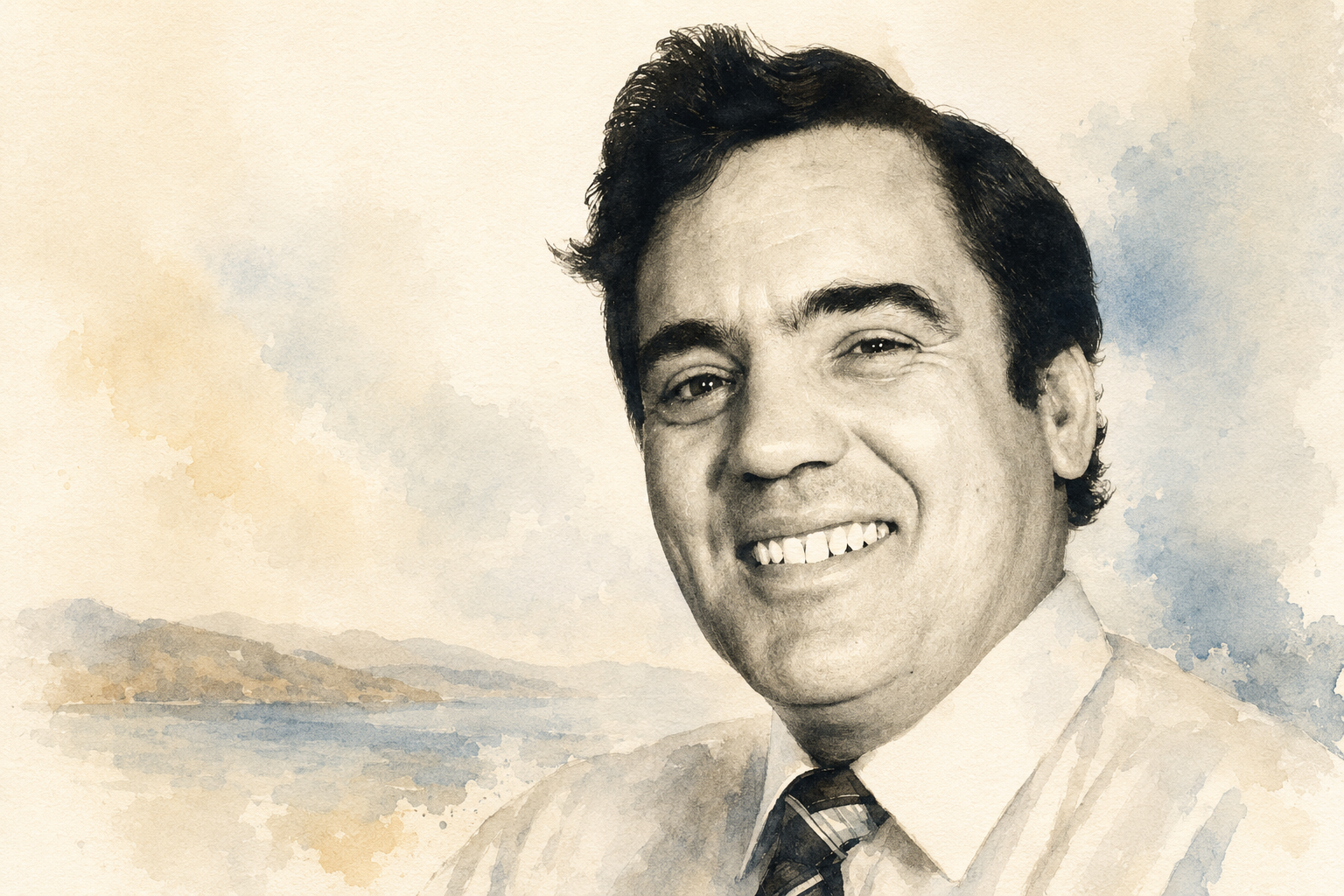
Before I tell you about Dad’s muscular dystrophy, I should probably tell you about Dad. His illness became an increasingly significant part of his life. But it wasn’t who he was.
Funny, kind and gentle
I asked Hayley how she would describe him. She gave me three words. Funny. Kind. Gentle. That seems about right.
Dad was a singer and a charmer. He was a great storyteller and a terrible cook. He loved talking to people and had an almost complete inability to say no to them.
At some point, a door-to-door salesman persuaded him to buy a very expensive vacuum cleaner. The vacuum cleaner got plenty of use. Just never by Dad.
He also thought Hayley was the best thing that could ever have happened to me. He was, of course, right about that.
He’d already lived quite a life
Dad didn’t have the easiest start.
When he was very young, his mother left him in a waiting room at a London railway station with a note saying that she couldn’t cope with him anymore.
His father served with the British Army in India and wasn’t around for much of his childhood, so Dad was largely brought up by two of his aunts, who ran a guesthouse on the Isle of Wight.
Even that arrangement had its quirks. During the busy holiday season, paying guests took priority. If the guesthouse filled up, Dad’s bedroom was rented out and he was moved outside to sleep in the shed.
It was certainly a very different childhood from mine..
At 16, he joined the Royal Air Force. He served for 22 years and, at the time, became the youngest Sergeant in the RAF.
His work took him to some extraordinary places. He served in Borneo and once found himself stranded in the jungle with his crew for four days after being flown in to repair a helicopter.
In the 1960s, he taught people to waterski. In the 1970s he played golf.
When I was about seven to nine years old, Dad lived just outside Cairo. He was working on a project trying to get MiG-21 aircraft that the Russians had left behind back into working order. He’d be away for three months and then come home for two weeks.
To me, of course, he wasn’t the RAF Sergeant or the aircraft engineer. He was just Dad.
The day Dad disappeared off stage
Dad loved singing. When I was about eleven, he was performing in a concert at the village hall.
At the end of one song, his chair somehow slipped off the back of the stage. Taking Dad with it. There was a gasp from the audience. I was absolutely mortified. I wanted the ground to open up and swallow me. Dad, meanwhile, got himself back up and then proceeded to sing his solo. I left and took myself home. Looking back, I’m not sure which of us behaved more dramatically.
Dad didn’t really do things by halves
He could be extraordinarily meticulous. We had a large lawn. And when I say large, I mean something like 100 metres long and 30 metres wide.
Dad would spend summer days sitting on it, shuffling himself up and down on his backside.
Why?
Because he was removing, by hand, every weed and every blade of grass that he decided didn’t belong there.
All 3,000 square metres of it.
This was a man who had spent his life around engineering and technical manuals, and I sometimes wonder whether he simply applied the same standards to the lawn.
He was also a painfully slow reader. Not because he struggled to read, but because he seemed to absorb virtually every word. Perhaps years of reading engineering manuals had taught him that you couldn’t just skim over the important bits.
Later in life he became an enthusiastic reader of fiction and moved onto an e-reader pretty much as soon as they became available. I bought him Airframe by Michael Crichton. It seemed perfect: part escape, part aircraft engineering.
The world’s most enthusiastic accelerator pedal
For a period of his working life, Dad received a new company car about every nine months. Each one seemed to be more powerful than the one before. This was unfortunate. Dad’s accelerator foot appeared to have only one setting:
Flat to the floor.
Acceleration with Dad could be genuinely neck-breaking.
Years later, as his physical abilities declined, he continued driving well beyond the point when I was comfortable with it.
Eventually I told him I thought it was time to hand the keys over to Mum. I’d expected that to be difficult. Instead, I think it was a massive relief to him. Dad quickly discovered that being a passenger had its advantages. He could now spend hours sitting beside Mum telling her everything she was doing wrong.
He loved people
This was perhaps one of the things that defined him most. Dad liked people. He liked conversation. I used to phone him on my journey home from work almost every night.
We’d talk for about half an hour. As a consequence, Dad knew far too much about the minutiae of my working day.
We lived a long way from Mum and Dad and physically saw them only a couple of times a year, which I regret. Those telephone calls meant Dad was still part of my everyday life.
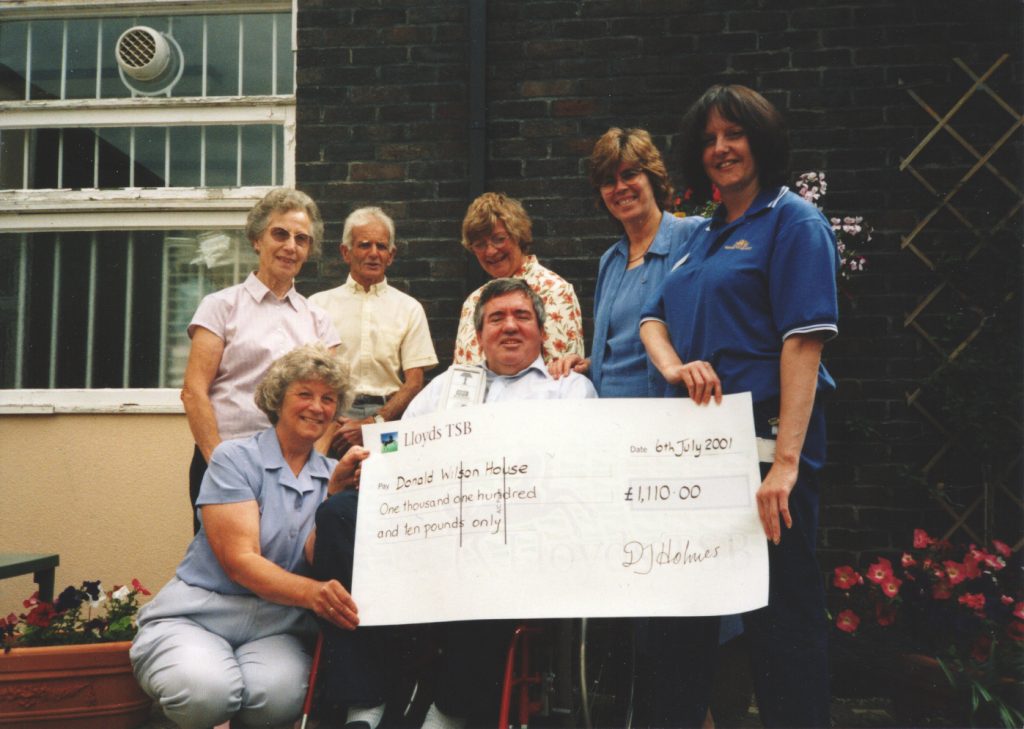
In retirement, he spent a lot of his time helping other people. He worked with the Citizens Advice Bureau and as a mediator. He was involved with the Friends of Sussexdown and with the Royal Air Forces Association.
And in his later years, Mum and Dad discovered cruising. This suited both of them rather well. Mum could disappear off exploring. Dad had access to an almost limitless supply of people to talk to.
His world began to change
Somewhere amongst all of this, Dad’s body began, and continued, letting him down. Things that had once been automatic became difficult.
His hands caused him a lot of pain. Standing became increasingly difficult. He felt the cold terribly as his condition progressed. Eventually there were things he simply couldn’t do anymore.
I’ve already written about one of the moments that has stayed with me: watching this former aircraft engineer unable to use a screwdriver.
But there were lots of smaller moments too.
Hayley used to sit with him and massage his hands because they hurt so much.
She also cut his hair using the same clippers she used on me. Dad, former RAF Sergeant, ended up looking like a grey squaddie. He seemed perfectly happy enough with the arrangement.
Dad hardly ever drank alcohol, but on the occasions when he did, we certainly knew about it. Standing up was difficult enough when he was completely sober. After a few drinks, it could become something of a disaster.
There was humour alongside the difficult stuff. There had to be.
Dad remained Dad
The muscular dystrophy progressively took things away from him. Eventually even driving had to go. Getting around became harder. His hands hurt. His strength declined.
But something I’ve realised while writing this is that Dad remained remarkably Dad-like throughout it all.
He still wanted to talk. He still wanted to tell stories. He still wanted to know what everyone else was doing. And he remained funny, kind and gentle.
The condition changed what he could do. It didn’t define who he was.

The question nobody could answer
There was one thing Dad never got. A name for what was happening to him. He saw doctors. He underwent investigations. We knew he had some form of muscular dystrophy. Nobody ever managed to tell us which one.
Dad died in 2011, aged 71, without receiving that answer.
Years later, when my own muscles began behaving strangely, his story suddenly became part of mine. When my CK levels came back elevated in 2017, one of my first questions was whether what was happening to me could be connected to Dad.
Eventually, after my own six-year search for an answer, a specialist in Newcastle suspected FSHD. And in June 2023, I finally received my diagnosis.
FSHD Type 2.
An answer for Dad?
My diagnosis can’t retrospectively diagnose my father. There was no genetic test confirming that Dad had FSHD2, but what I’ve inherited is the condition I watched Dad live with.
That made my diagnosis mean something beyond understanding what was happening to me. Dad had died twelve years earlier without ever being able to give his illness a name. Now I finally could.
I wish a diagnosis had been there for him. I suspect he’d have wanted to know absolutely everything about FSHD. He’d have read every piece of information he could find. Very, very slowly. Every single word.
And then he’d probably have rung me to tell me about it.